Connect functions across different language
I designed matching around the function a capability serves, so different terminology does not obscure a relevant opportunity.
Whitespace starts with a company’s products, services, and performed work, then finds documented government needs and explains the fit. It connects company evidence, federal awards, budget justifications, and procurement notices into sourced opportunity reports.
 View full concept ↗
Product direction, architecture, evaluation criteria, and agent-assisted implementation.
A working engine for company research, government-evidence ingestion, capability-to-demand matching, and independently checked opportunity reports. Current development is expanding and validating the government evidence library.
A company describes its products and services in its own language. Government buyers describe missions, operating conditions, programs, and requirements. A useful match has to connect what the company does to the function the buyer needs.
Growth leaders need to see where those capabilities fit beyond familiar customers, what evidence supports the connection, and whether the timing and acquisition route make an opportunity worth pursuing.
I organized Whitespace around four components: capability records, a government evidence library, search and relationships, and reasoning and verification. Company evidence and government evidence are independent foundations that the analysis brings together.
Company research and government evidence accumulate over time, making each analysis part of a growing research asset.
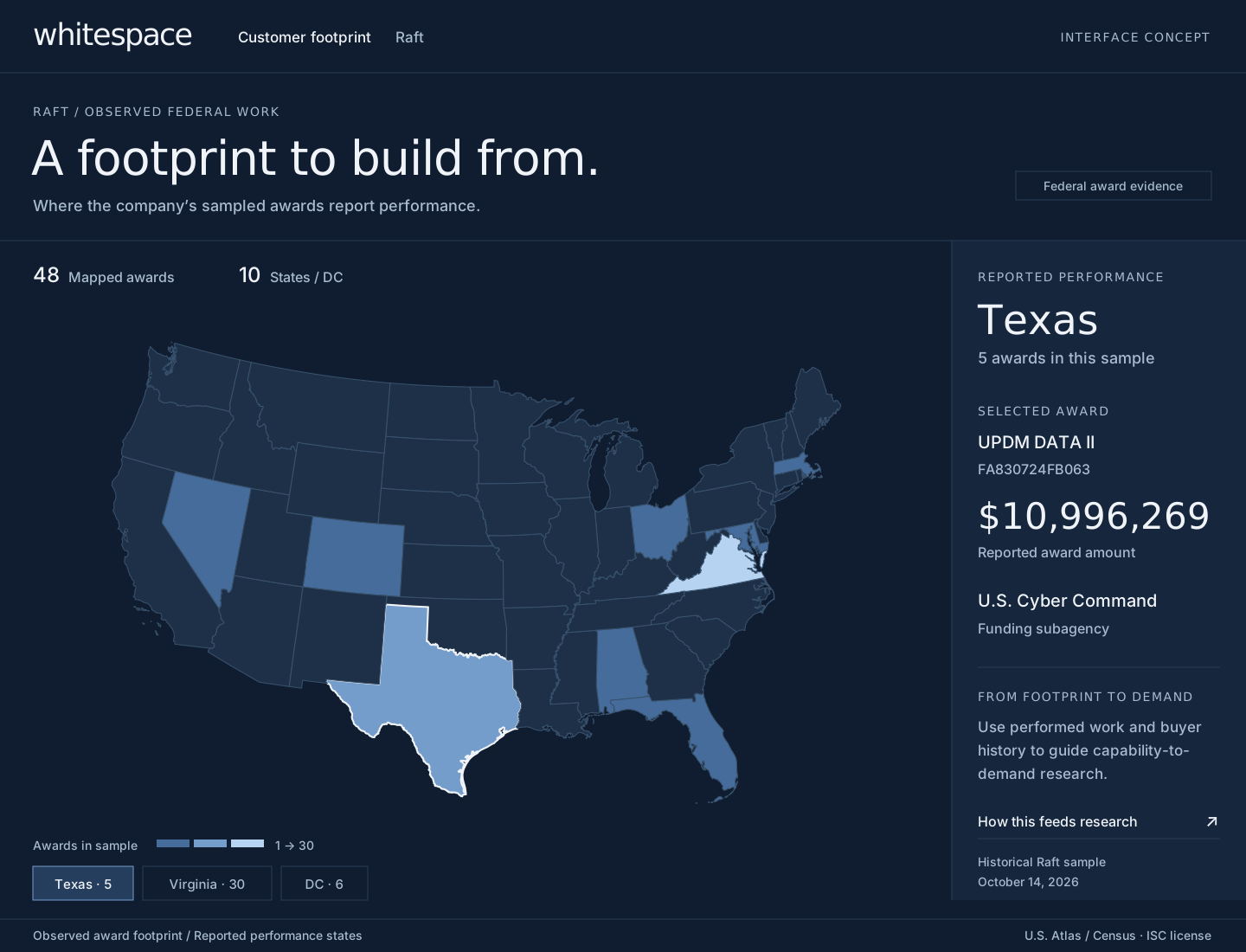
The engine reads company offering pages and supporting documents, extracts products, services, and technologies, and checks quotations against the captured sources. Federal award history adds evidence of performed work and existing buyers.
Government ingestion turns budget exhibits and procurement notices into searchable records. The system connects company capabilities with relevant government needs, including buyers beyond the company’s existing footprint. Each opportunity card then explains the need, capability fit, money, timing, access, unknowns, and next step.
Build an evidence-backed understanding of what a company offers and where it has delivered.
Build a reusable picture of government needs, supported by budget and procurement evidence.
Identify where company capabilities could serve relevant missions and new buyers.
Explain each recommendation, its supporting evidence, and the questions that remain.
I designed matching around the function a capability serves, so different terminology does not obscure a relevant opportunity.
I made independent verification part of the workflow. Recommendations must stand up against the underlying evidence, including the limits of the claimed fit.
Cards distinguish direct, adjacent, and stretch fits. A budget request keeps its fiscal year and funding status. Response deadlines, notice type, eligibility, and contract vehicles are separate parts of the decision.
Research accumulates across company analyses, improving continuity and reducing repeated work. Coverage, extraction, retrieval, and final usefulness are evaluated separately.
As of October 24, the rebuilt engine has generated capability inventories and opportunity reports for eight test companies. Testing across eight companies has shaped the matching approach and exposed gaps in the evidence base.
Current development is expanding government-source coverage and strengthening the evaluation of opportunity quality.
An accurate card cannot compensate for a missing source. Testing capability extraction, document coverage, retrieval, and final reasoning separately made it possible to see where useful opportunities were being lost.
The product became clearer when I treated the evidence library as a lasting asset and each company report as one use of it. Better sources and better connections improve every subsequent analysis.